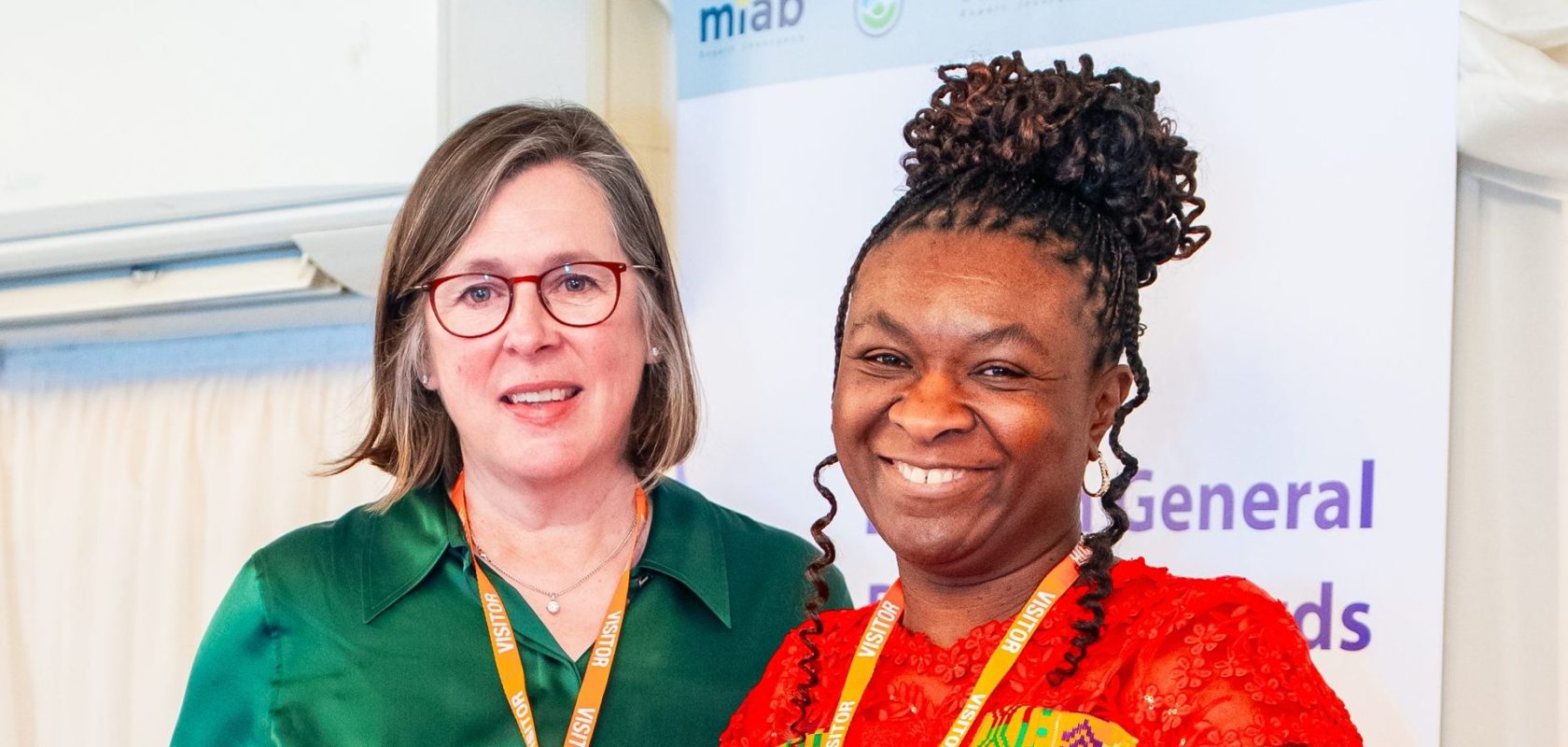
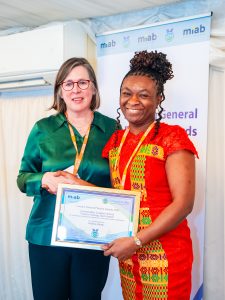
Gill Rogers, one of the judges and Barbara Abotsi.
On 5 February 2026, at the London General Practice Awards, Barbara Abotsi was commended with the London General Practice Nursing Team Award.
The nomination came in as a surprise to Barbara who is the Advanced Clinical Practitioner at Wells Park Practice.
“The award was completely unexpected. I was nominated by my manager, largely because of the work I have done building and sustaining our nursing team.
“When I joined in 2017, the nursing team was small and had high turnover. Over time, colleagues left, and for a while I was the only fulltime nurse. To keep the service going, we hired newly qualified nurses, and I ended up training five of them. Many eventually moved on due to childcare or travel constraints, but the experience strengthened my commitment to developing new talent.
“Today, I am proud to say we have the strongest team we have ever had. One nurse joined us as a healthcare assistant and, through apprenticeship and mentorship, is now fully qualified. Another is the only male practice nurse in Lewisham—and he’s thriving. Our healthcare assistant began as a reception apprentice and is now trained to assist clinically and even teach reception staff phlebotomy and basic clinical tasks. Their dedication is what makes my job easier. I always tell them that this award is truly theirs,” she said.
Supporting a vulnerable community through compassionate, team driven care
Barbara continued, “Our practice is built on a team of around ten people, including four GP partners, 12–15 GPs, nurses, healthcare assistants, care coordinators, and a non‑clinical practice manager who is also a partner. We work in a socially deprived area with a registered population of around 20,000 residents, spanning both young families and older people.
Many of our patients face challenges related to mental health, housing insecurity, and homelessness, making our work both complex and essential.
To support our community, we host regular carers’ meetings and coffee mornings for vulnerable adults and their carers. We also hold Macmillan and St. Christopher’s Hospice fundraising events and involve our staff to help strengthen ties with local support services.”
A collaborative moment that transformed a life
One patient’s journey stands out as a powerful example of how deeply effective true teamwork can be.
“There was a lady in her seventies, with very poorly controlled diabetes, and she had been seen by each nurse on our team. Despite our efforts, her blood sugars remained high, and her eye surgery kept being postponed.
“When we finally brought her in together to review her medications, we discovered the core issue – she could not see the insulin pen well enough to dial the correct dose. We had been increasing her insulin, not realising she was not physically able to administer the higher amounts.
“Starting from scratch, we coordinated with district nursing to support her until her eye surgery. Although she was reluctant to lose independence, she agreed—and after surgery, her transformation was remarkable. She now exercises in the park and encourages other community members to manage their health. She even laughs about how we finally ‘caught her out.’ This case reminded us of all the importance of revisiting the basics, especially with vulnerable patients,” Barbara smiled.
The challenges we face
“Like all practices, we manage heavy workloads. However, we are fortunate to have a manager with a genuine open-door policy, who offers flexibility when personal needs arise.
“The biggest challenge stems from the deprivation in our community. Many diabetic patients struggle because healthy food is unaffordable. Immunisation uptake can also be low, even with frequent outreach. Some days we feel limited in how much we can help, simply because structural barriers are so deep.
“Space is not a major issue for us anymore—we recently expanded and added consulting rooms. On busy days, we rotate smoothly; one clinician exits a room as another enters. There is a strong culture of cooperation.
“The hardest part is wanting to give your absolute best but recognising that there are limits to what you can do for patients. Those limitations are what I see as the biggest barriers,” Barbara concluded.