
PSR has applied in England since 1 January 2024 and sets out a small number of permitted ‘routes’ a commissioner can use to award, renew or change a contract.
Note: This page is for information only and is not legal advice.
Why it matters to general practice
- Services delivered by practices (e.g. core GMS/PMS/APMS, locally commissioned services / local incentive schemes, enhanced services run locally) are funded via contracts that are in scope of PSR.
- PSR is designed to avoid unnecessary tendering, but it still requires clear documentation, transparency, and fair treatment of providers.
- Even if the service is ‘in primary care’ a contract award decision may still sit under PSR and therefore be subject to applicable rules.
The main routes for PSR
Please also refer to flow-chart further below, the full NHS England PSR guidance is here.
| Route | When it is used | How it is done |
| Direct Award A | Where the existing provider is the only provider capable of delivering the service (e.g. unique assets, highly specialist provider, no competition). | The commissioner documents why only one provider can do it and awards directly (no competition). |
| Direct Award B | The commissioner is not limiting the number of providers and is willing to (or must) contract with all who meet the minimum requirements. | Usually an open sign‑up/EOI: providers confirm interest and pass basic checks; those who meet requirements are offered a contract. |
| Direct Award C | An existing contract is ending, the service is continuing without significant change, and the current provider is performing well. | The commissioner can renew the incumbent but must publish its intention and apply standstill/representations steps. |
| Most suitable provider (MSP) | Where the commissioner can identify the best provider without running a full competition (e.g. clear local fit, outcomes, and value). | A light touch comparison against stated criteria, then standstill/representations before award. |
| Competitive process | Where the commissioner wants/needs competition (e.g. there are multiple capable providers and there is a need to select one or a limited number). | A tender with defined evaluation criteria, scoring, and standstill/representations before award. |
What practices may see in a PSR process (and why)
- The route chosen affects what information practices are asked for, how quickly awards can be made, and what opportunities exist to participate. Generally, you will see:
- A service specification – what must be delivered (scope, eligibility, staffing, governance, reporting, quality standards, digital and premises requirements, activity volumes, and tariffs).
- An invitation to participate – this could be an expression of interest (EOI), sign-up form, or tender invitation via a commissioner approved portal, depending on the PSR route.
- Assurance and declarations – commissioners often use standardised ‘selection’ questions (e.g. serious offences, tax compliance, conflicts, insolvency). These are generic public-sector checks and usually straightforward for practices, but they are formal declarations.
- Evidence on request – practices may be asked to provide supporting documents (e.g. policies, governance arrangements, insurance, CQC details, workforce competency evidence) if the commissioner needs more assurance.
- Transparency steps: depending on the route, the commissioner may publish notices and apply a standstill/‘representations’ period before confirming the award. The standstill period is a short window after the commissioner has made (or published) its intended award decision during which providers can raise concerns or challenge the process before the contract is finalised.
What changes between routes?
- How competitive it is – some routes are effectively ‘award/renew’ decisions; others involve comparing providers; the competitive process is the most formal.
- How much paperwork – direct awards are typically lighter-touch than competitive processes, but still require declarations and records.
- How quickly decisions can be made – direct awards and MSP can be quicker than a full tender, but may still include a standstill/representations period.
NHS England Provider Selection Regime: getting to the right decision (flowchart to support choice of PSR route)
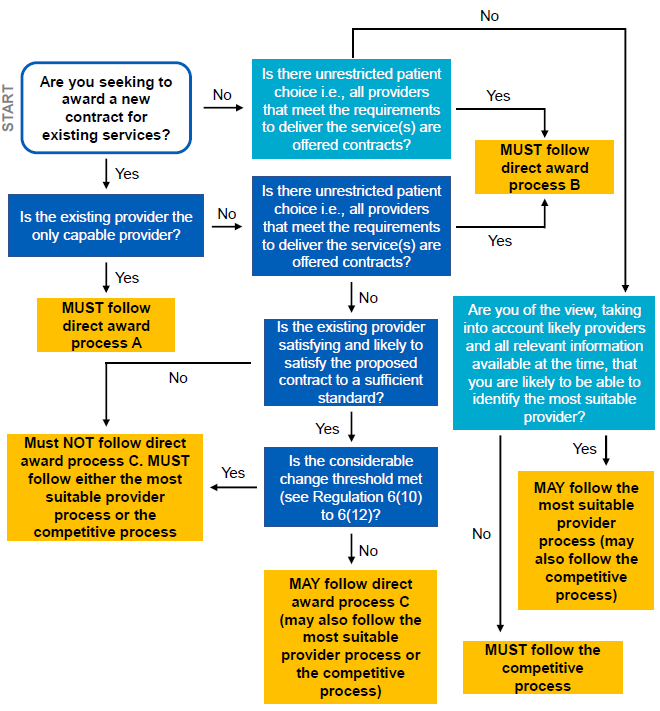
PSR is the legal framework the NHS must use when it commissions (buys) most healthcare services. It sets out the permitted ways a commissioner can award, renew or change a contract.
Why does the commissioner need to run a ‘procurement’ for some GP services?
- It is spending public money and must have a lawful route to award a contract (or renew/replace one).
- This includes some services delivered in general practice (e.g. LIS/LES schemes).
- It may be a new service, a replacement for an expiring contract, or a change in delivery model.
What PSR routes exist?
Also refer to the above quick guide for more info.
| Route | When it is used |
| Direct Award A | Where the existing provider is the only provider capable of delivering the service (e.g. unique assets, highly specialist provider, no competition). |
| Direct Award B | The commissioner is not limiting the number of providers and is willing to (or must) contract with all who meet the minimum requirements. |
| Direct Award C | An existing contract is ending, the service is continuing without significant change, and the current provider is performing well. |
| Most suitable provider | Where the commissioner can identify the best provider without running a full competition (e.g. clear local fit, outcomes, and value). |
| Competitive process | Where the commissioner wants/needs competition (e.g. there are multiple capable providers and there is a need to select one or a limited number). |
What does Direct Award B mean for GP practices?
- The commissioner has decided not to restrict (or is not permitted to restrict) the number of providers who can deliver certain services.
- It is effectively an ‘open contract offer’: contracts can be awarded to all providers that want to deliver the service and meet the minimum requirements. It is not a competitive tender: you are not ‘bidding against’ other practices.
- The commissioner will typically run a short EOI/questionnaire to confirm (1) you want to opt in; (2) you can deliver the service; and (3) you pass basic ‘exclusion’ checks used across public procurement.
- The commissioner will outline the timescales for submitting your expression of interest. In some cases, the process may not be time limited, and practices may be able to sign up at any time.
What type of questions will practices be asked?
- Commissioners typically base their EOI forms on a standard UK Government set of procurement questions used across the public sector and often include ‘selection’ and ‘exclusion’ declarations (for example, serious offences or tax compliance).
- These questions are written to cover all supplier types, so the wording can feel disproportionate for general practice. For more detailed explanation of each question, please refer to: please refer to the guide below: PSR Direct Award B – Annex B EOI Selection Questions – Quick Guide for GP Practices’
- LMCs have raised concerns with commissioners that some exclusion questions, as written, could be interpreted as requiring assurance about matters a practice cannot reasonably and fully verify. The expectation should be a proportionate declaration that still meets legal requirements.
| Question type | What they are checking | Tips for practices |
| Provider details & service readiness | Identity of the practice (usually Name and ODS code) and whether you can deliver the spec | Check the spec and the minimum requirements. |
| Mandatory exclusions (serious offences) | Whether people who control the organisation have recent convictions (usually last 5 years) for specified offences. | For practices, this is usually ‘No’. If unsure, check with partners/directors. If you answer ‘Yes’ to any exclusion question, you must give details and explain any mitigations |
| Tax and National Insurance compliance | Whether your organisation has met tax/NI obligations | Usually ‘Yes’ (compliant). If there is an issue, disclose and explain arrangements to pay. |
| Discretionary exclusions | Other risks (e.g. grave professional misconduct, insolvency, conflicts, poor performance) | If you answer ‘Yes’ to any exclusion question, you must give details and explain any mitigations |
| Modern Slavery Act statement | Only applies to organisations with turnover >= £36m | Most practices will be ‘Not applicable’ – confirm your turnover threshold. |
| Confidential information / FOI note | The ICB may have to disclose information under FOI | Only mark genuinely confidential items and be specific (a blanket ‘confidential’ response is rarely accepted). |
What should practices do?
- Read the service specification and confirm that you can meet the requirements.
- Check the deadline for submission of the EOI. If unsure, contact the commissioner (and copy your LMC). You must submit according to the deadlines set by the commissioner.
- Complete the EOI/questionnaire accurately – In PSR Direct Award B, the commissioner still needs a clear audit trail that basic checks were completed.
- Answer every question. They will typically be ‘Yes’/’No’ questions. If you answer ‘Yes’ to any exclusion question, you must give details and explain any mitigations or remedial actions.
- Keep a copy of your submission and any supporting evidence.
- If requirements or processes are unclear, raise this early to the commissioner (and copy your LMC).
References
Expression of Interest forms used for PSR Direct Award B processes typically contain a number of standard questions:
- to confirm that your practice wants to opt in to deliver the service and can meet the key requirements in the service specification;
- to give the commissioner a lawful ‘audit trail’ under PSR Direct Award B that basic checks were completed before offering a contract;
- to capture standard public‑sector declarations (e.g. serious offences, tax compliance) that apply across all sectors.
Commissioners commonly use the UK Government’s Standard Selection Questionnaire (Annex B) as a template.
Proportionality (key reassurance)
LMCs have raised with commissioners that the Annex B questions are designed to work for any type of supplier, and the wording of some exclusion questions can appear disproportionate for general practice – specifically, where compliance is sought ‘anywhere in the world’. LMCs believe that a proportionate interpretation should be expected, while still staying within the legal requirements. Declarations should be made to the best of the practice’s knowledge and based on information reasonably available to the organisation. Practices should not be reasonably expected to conduct global or investigatory checks beyond normal processes such as:
- UK employment and recruitment checks (including right to work).
- DBS checks (where applicable).
- Verification of professional registration (e.g. GMC, NMC).
- Self-declarations from partners, directors, or senior staff.
How the questions are structured
Part 1 – General information: practice details and service readiness (often short yes/no confirmations).
Part 2 – Grounds for Mandatory and/or Discretionary exclusions:
- Mandatory exclusions (serious offences): yes/no declarations about specified offences (normally ‘No’ for practices).
- Tax and social security: confirmation you have met obligations (normally ‘Yes’).
- Discretionary exclusions and Modern Slavery Act: further risk checks (often ‘No’ or ‘N/A’ for practices).
Commissioners may also decide to include additional questions specific to a procurement/service. For example:
- they may ask the provider to identify genuinely confidential parts of your submission (if any) for FOI purposes;
- they may ask practices to confirm they have read the service specification and that they confirm they are eligible and able to meet all the requirements in the spec to deliver the service.
Please see table further below for detailed description of questions.
This guide is provided for general information only and does not constitute legal, financial or professional advice. Any model responses are illustrative examples intended to help practices understand the questions; they are not definitive. Each practice must determine its own responses based on its specific circumstances and should obtain independent advice if uncertain.
| Annex B question | What it means |
| Part 1 | |
| Organisation details (name; address; website; trading status; date of registration/formation; registration number; VAT number) | Details of your organisation requested. Some details will only apply if a practice is incorporated (trading status, date of registration, registration number). Organisation identifier can be ODS code. If a field is not applicable (e.g. VAT number), enter N/A. |
| Are you registered with the appropriate professional/trade register(s) specified for this procurement and as set out in the procurement documents in the country where your organisation is established? | The question checks that the required registrations for this service are in place (only those stated in the procurement docs/spec). YES = you are registered; provide details/evidence. NO = you are not registered; if registration is required, you may be ineligible unless you can register by the start date. Typically YES if CQC (or similar) is required. ‘Country’ here will ordinarily be England. |
| Services only: Is it a legal requirement in the country where you are established for you to possess a particular authorisation OR be a member of a particular organisation to provide the service? | The question checks whether any authorisation / membership is legally required. YES = provide details and confirm compliance. NO = nothing additional. Usually NO (unless the spec states a required authorisation/membership). |
| Relevant classifications (VCSE / sheltered workshop / public service mutual) AND Small/Medium Enterprise (SME) status. | Classification questions. YES = states which category. NO = none apply. SME = YES/NO, please check with your organisation. Classifications: typically NO. SME: typically YES. |
| Persons of significant control (PSC) details (where appropriate) AND parent company details (immediate/ultimate) | Mainly for incorporated entities/corporate groups. If applicable, provide PSC/parent details. Often N/A (e.g. practices with traditional partnerships and no parent company). If unsure, check your legal structure. |
| Single supplier or group/consortium (and, if consortium, details of the group structure/lead/roles and whether you rely on others to meet selection criteria) | This question identifies whether this is a joint bid. Single supplier = no further consortium detail. Group/consortium = provide the listed information; if relying on another member to meet the selection criteria, be clear who does what. Usually single supplier; consortium details N/A. |
| Subcontractors/supply chain details (if any) AND (optional) lots | Only relevant if you plan to subcontract any delivery. YES (subcontractors) = list each subcontractor and what they will do. NO = state no subcontractors. If lots apply, select the relevant lot(s). Typically no subcontractors (N/A). Lots also often N/A. |
| Part 2 | |
Mandatory exclusions – Within the past five years, anywhere in the world, have you or any person who is a member of the supplier’s administrative, management or supervisory body; or has powers of representation, decision or control in the supplier, been convicted of any of the offences within the summary below and listed in full in Annex D?
| Serious offence declaration. YES = a relevant conviction exists; you must provide details and ‘self-cleaning’. NO = none known. Answer this question based on information reasonably available to you (normal UK recruitment/DBS checks + staff/partners declarations) – practices cannot be reasonably expected to investigate globally. Typically NO. |
| Mandatory exclusions follow-up: if YES, provide details/evidence (date of conviction; ground for conviction and reason; identity of who has been convicted; documentation) AND explain ‘self-cleaning’ measures | To be completed only if you answered YES to any of the exclusions above. Provide factual details and any evidence links. ‘Self-cleaning’ is your explanation of remedial steps and controls that demonstrate reliability (governance, training, policies, oversight). Typically N/A (unless YES above). |
| Tax/social security: Please confirm that you have met all your obligations relating to the payment of taxes and social security contributions, both in the country in which you are established and in the UK. | YES = tax/NI up to date. NO = you must provide details and also confirm repayment plan/arrangement. If NO, check with your accountant and disclose relevant details accurately. Typically YES. |
Discretionary exclusions: Within the past three years, anywhere in the world, have any of the situations summarised below and listed in full in Annex D applied to you?
| Wider risk checks. YES = one or more issues apply; you must explain context and mitigations. A YES answer is not automatically disqualifying, but the commissioner will want clarification/details and may request evidence. NO = none apply. Answer based on information reasonably available to you (normal UK recruitment/DBS checks + declarations) – practices cannot be reasonably be expected to investigate globally. Typically NO. |
| Do any integrity statements apply (misrepresentation/withholding info/unable to submit documents/undue influence)? | YES = one or more issues apply. NO = none apply. |
| Modern Slavery Act: If you are a relevant commercial organization (UK goods/services + turnover ≥ £36m), please confirm: you have published a compliant statement. | If not in scope, state that clearly. If in scope and you cannot confirm a complaint statement has been published, answer NO and explain what action you will take (and the timescale). Usually not in scope (N/A). |