
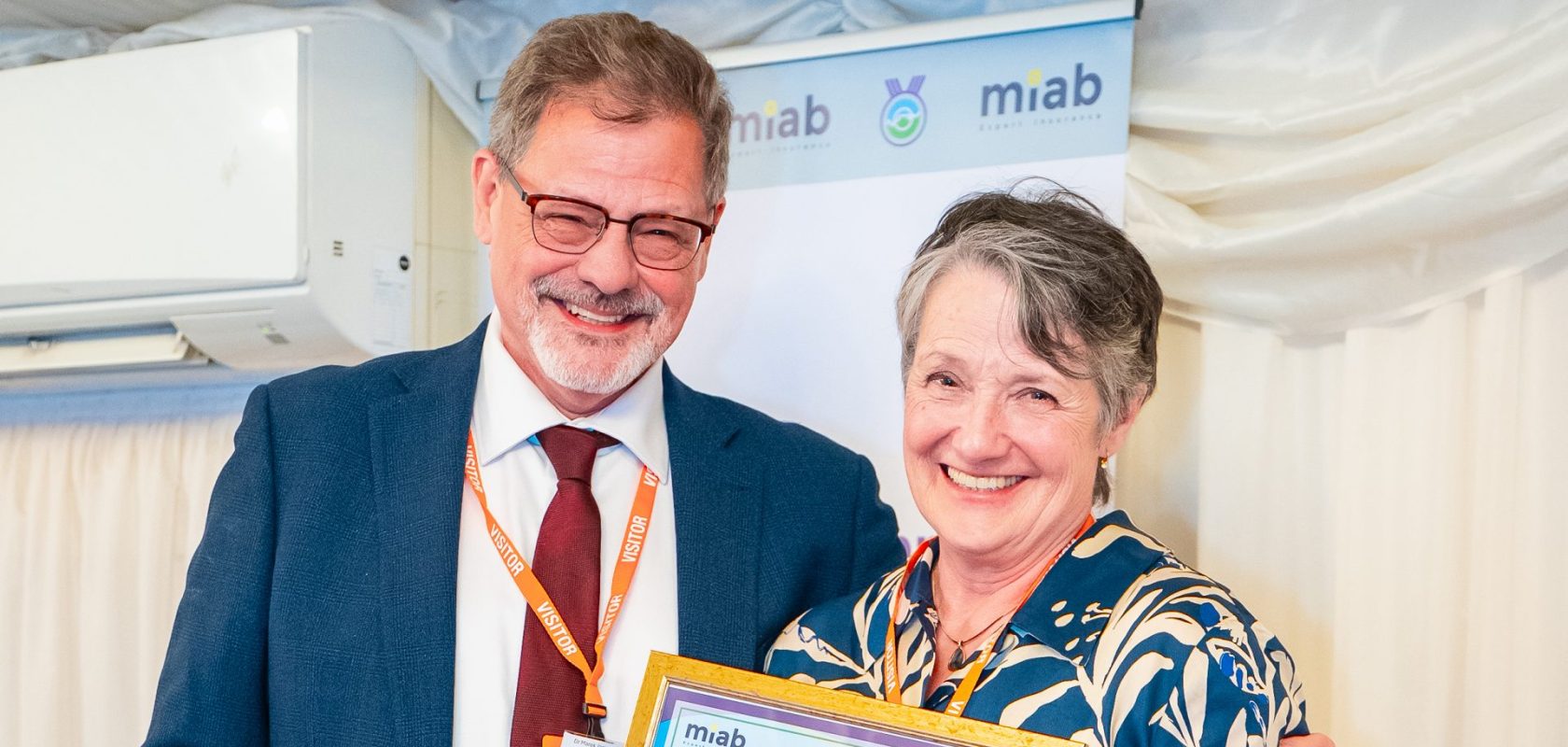
Marek Jarzembowski, one of the judges and Emma Rowley-Conwy.
At the London General Practice Awards held on February 5, 2026, Dr Emma Rowley-Conwy was the winner of the London General Practice Long Service Award.
Emma, GP Retainer at The Exchange Surgery, reflects on more than two decades of transformation in her practice, describing how she rebuilt the surgery into a thriving multidisciplinary team and a hub for diverse communities.
Award recognition rooted in consistency and leadership
Asked why she believes she was chosen for her award, Emma said: “I have taken on two practices since 1991 and been part of turning them around. In 2003 I moved to my current practice and began the process here.”
“It’s just that consistency — when you feel like this is hard, I want to give up… you just keep going.”
Emma has held numerous leadership roles: “I was on the local medical committee for 25 years, I was on the professional executive committee of the primary care groups, and when we became an integrated care board, I became a primary care network clinical director.
“I’ve always had a foot in the management and leadership camp outside the practice, which I think really helped shaped who I am today.”
From single‑handed GP to large multidisciplinary team
“When I took over the practice in 2003, I was basically a single‑hander,” she explained. “I had one salaried GP, a practice manager and two receptionists. I recruited a nurse.”
Today, the practice has grown significantly: three partners, three salaried GPs, three registrars, a practice nurse, and a nurse on placement. “We’ve probably got about 12 reception staff — I can’t quite keep track of them,” she laughs. The team also includes both a practice manager and an assistant practice manager.
The practice moved into a purpose‑built polyclinic in 2007.
“We’ve got hospital services and we did have council services, but now we’ve got mental health and community services available,” Emma says.
“One of the things I’m most proud of is the legacy of the staff I’ve supported and trained.”
Her practice manager started as a receptionist and now has an MBA and is a managing partner. Nurses and receptionists have moved into advanced roles; PCN pharmacists have been supported to become independent prescribers.
“Staff feel they are being invested in — and that rubs off on patient experience,”
“Patients like seeing staff develop. They gain confidence in the care they are receiving,” she said.
A diverse patient population
“Lambeth tends to be quite a young borough so sometimes we see a big turnover – very mobile as lots of people who live in flats move on,” she said. The population is marked by moderate to high deprivation and rich cultural diversity.
She continued, “I think we’ve got every single type of ethnicity. Lots of second‑generation Asian and African‑Caribbean families, a Somalian population, and a considerable number of East Europeans.”
The practice has also become a hub for Spanish‑speaking patients. “Because we have Spanish‑speaking staff, we’ve kind of taken in a load of Spanish speakers.”
“Luckily, I can understand quite a bit of Spanish,” she smiles. “One of my colleagues speaks Spanish fluently and another is so proficient they can effectively conduct consultations, which is quite helpful.”
A passion for digital tools
When asked about her interest in the use of technology in general practice, Emma explained, “I just think digital can be a real enabler,” she said. “If it works for you, if it’s designed with you in mind, it can make you really efficient.”
Emma has been involved with the EMIS clinical record system and the South East London Local Care Record, both of which aim to streamline the way clinicians’ access and share information.
She described how effective digital tools can transform a patient interaction:
“Digital tools are so efficient because when a patient comes into your practice and says, ‘I had a scan, I don’t know what it was and nobody has rung me,’ I can pull it up and say, ‘Let’s have a look, here it is, the result is all fine.’
“It gives patients enormous confidence in their GP, that you know what you are doing and they can trust you. It looks professional and competent rather than saying, ‘I don’t know where your results are or I am not sure what’s going on.’ So, if digital works, it can be amazing.”
However, Emma cautions against getting caught up in the excitement of new digital tools, saying that no product is a complete solution on its own. For her, technology only has real value if it genuinely focused on patients.
“You can get involved in a product and think it is the ‘be all and end all’— and it is not. It only works if it gives me more time with the patient,” she said.
Emma calls that “a real truism” that continues to guide her decisions about the digital tools she chooses to adopt.