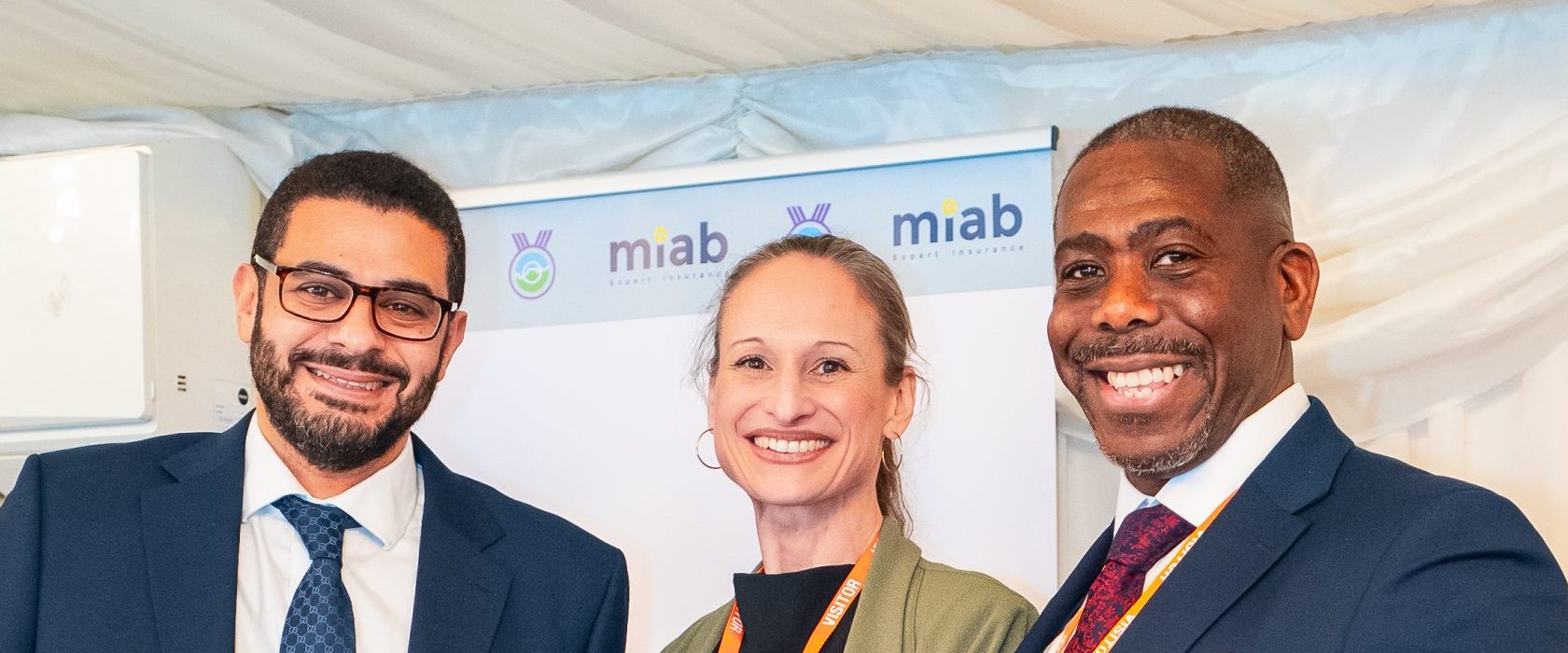
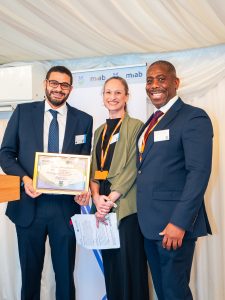
Mark Mikhail, our CEO Dr Lisa Harrod-Rothwell and Montrose Bill from sponsors MIAB.
At the London General Practice Awards on 5 February 2026, Mark Mikhail was the winner of the London LMC Member Award: North West London.
When he collected the award, it carried a significance that went far beyond the ceremony itself. He felt honoured to receive the award.
“My dad was a GP and my mum was an ophthalmologist,” he says. “They came over in the 1980s, worked incredibly hard, and never really received any formal recognition. For them to see this and feel that their work — and sacrifices — are being recognised through their son meant a lot.”
It is a sentiment that speaks to the quiet dedication that defines so much of general practice. “I never thought I’d be the kind of person to stand up and collect an award,” Mark reflects. “I just see myself as a working GP, trying to help patients and fix system problems.”
A practice rooted in its community
Mark leads a practice in Southall with deep roots in the local area, having served the community from the same converted house since 1939 — predating the NHS itself. Serving around 3,000 patients, the team is small but highly effective: a practice manager, nurse, healthcare assistant, two GP assistants, and a reception team.
“We’re small, but we work very efficiently,” he says. “That’s essential, because we operate in a very deprived area with extremely high demand and lots of comorbidity.”
The practice serves one of London’s most ethnically diverse populations, with some of the highest rates of diabetes in the country. “We’re in the heart of Southall, which is now predominantly Asian,” Mark explains. “But because the practice has been here for so long, we also care for older Caucasian, Irish, African Caribbean, European, and Somali communities.”
That diversity demands flexibility and cultural intelligence. “You need different approaches for different communities — sometimes it’s about understanding cultural expectations, sometimes it’s about building trust.” Clear communication about medicines and treatment is also central to safe care. “A lot of people don’t fully understand what medicines are for. You have to take the time to explain — that antibiotics treat infections, not arthritis. It takes time, but it is essential.”
The practice has developed a clear model to manage its workload: splitting same-day urgent care from planned chronic disease management, while ensuring patients are never turned away. “If someone feels their problem is urgent and we don’t feel so clinically, we don’t argue with them — we book them in. We can do that because we work as a team.”
From anecdote to evidence
Mark was recognised for his persistent, evidence-based advocacy on behalf of general practice across North West London. Deeply operational by nature — “I’m in the practice most days, and even when I’m not, I’m logged in” — he has developed a sharp instinct for spotting system-wide problems from the ground level.
“I often message practices across Ealing and more widely across NWL, usually on WhatsApp, and ask, ‘Are you seeing this problem?’ Then I get tens of replies confirming they are.”
Where others might accept reassurances that concerns are merely anecdotal, Mark pushes further. “Some often dismiss things as anecdotal — so I focus on turning those anecdotes into data.”
This approach proved critical when he identified serious errors in pathology services. After being told that incorrect blood test results were isolated incidents, Mark conducted a borough-wide data search and found that the proportion of abnormal results for certain tests was far higher than the expected 2–5%. Presented with this evidence, the pathology provider was compelled to act, bringing in a professor of haematology and investigating equipment and reagent failures.
“They never said, ‘You were right,’” he notes with characteristic understatement. “But the problem went away — and that’s what matters.”
Speaking up when it matters
The same principled persistence has seen Mark challenge unsafe practices across other parts of the system. He raised sustained concerns about the discharge of patients on depot antipsychotic injections from secondary care into general practice, at a time when many in the system were unwilling to listen.
“These patients are often described as ‘stable,’ but mental illness doesn’t work like that. You don’t cure it — you manage it, and at best it’s in remission. These patients often don’t have insight and may not engage.”
Following serious incidents and a survey in which around 90% of practices confirmed the service was unsafe, the voices of GPs were taken seriously. The pathway was redesigned with meaningful input from general practice, resulting in mental health workers being embedded in practices and tighter controls around discharge.
Mark also engaged with proposals around palliative care referral pathways. “These are people at the end of their lives — you can’t take away their dignity. This isn’t like triaging a cough.” Through constructive challenge and early intervention, GP perspectives were incorporated into the redesign, resulting in a pathway better suited to the needs of dying patients and the practices caring for them.
Leadership beyond the consulting room
Alongside his clinical work, Mark serves as a Clinical Director in his Primary Care Network and chairs the local Federation. His community focus spans social prescribing, patient participation, cancer screening, and vaccine hesitancy — as well as leading the at-scale Covid vaccination rollout and Covid hubs during the pandemic.
It is a breadth of contribution that the LMC award rightly recognised. But for Mark, the motivation remains constant and clear: be present, spot the problems, gather the evidence, and act — all in the service of better patient care, a more sustainable general practice, and meaningful support for colleagues facing unprecedented pressures.