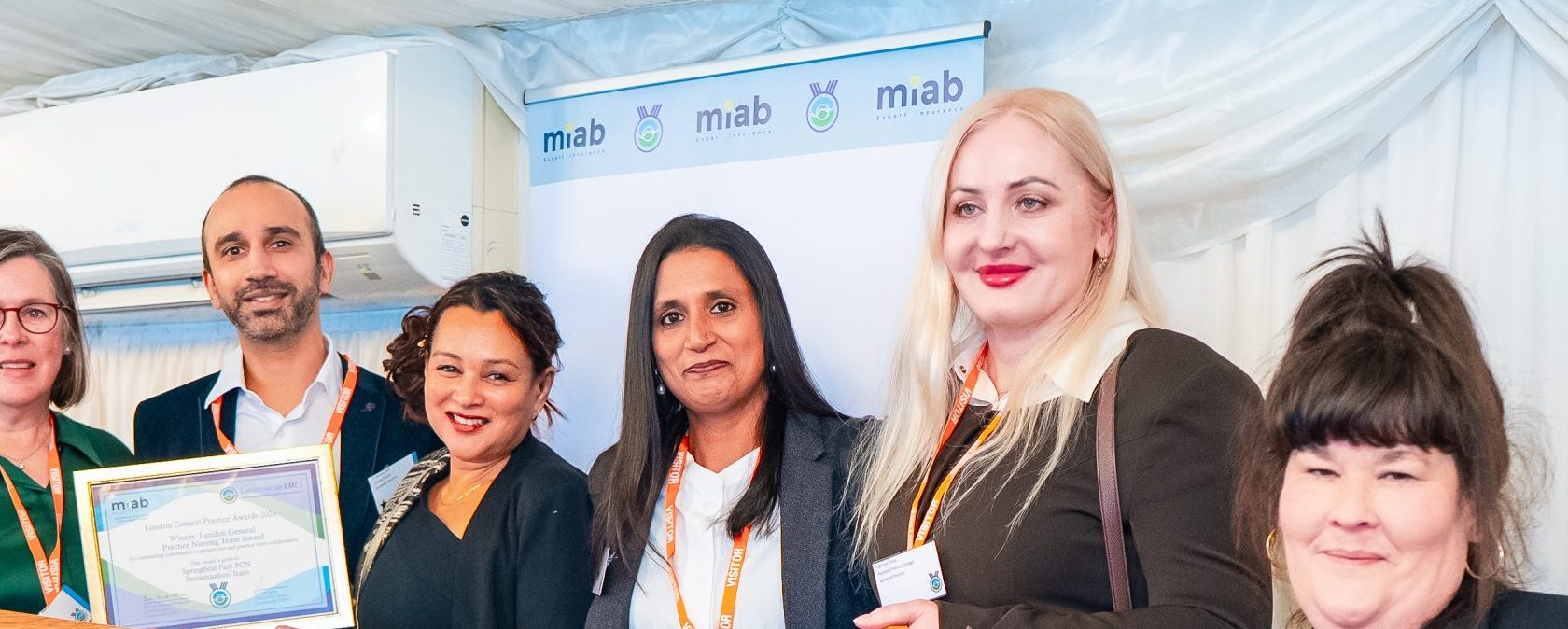
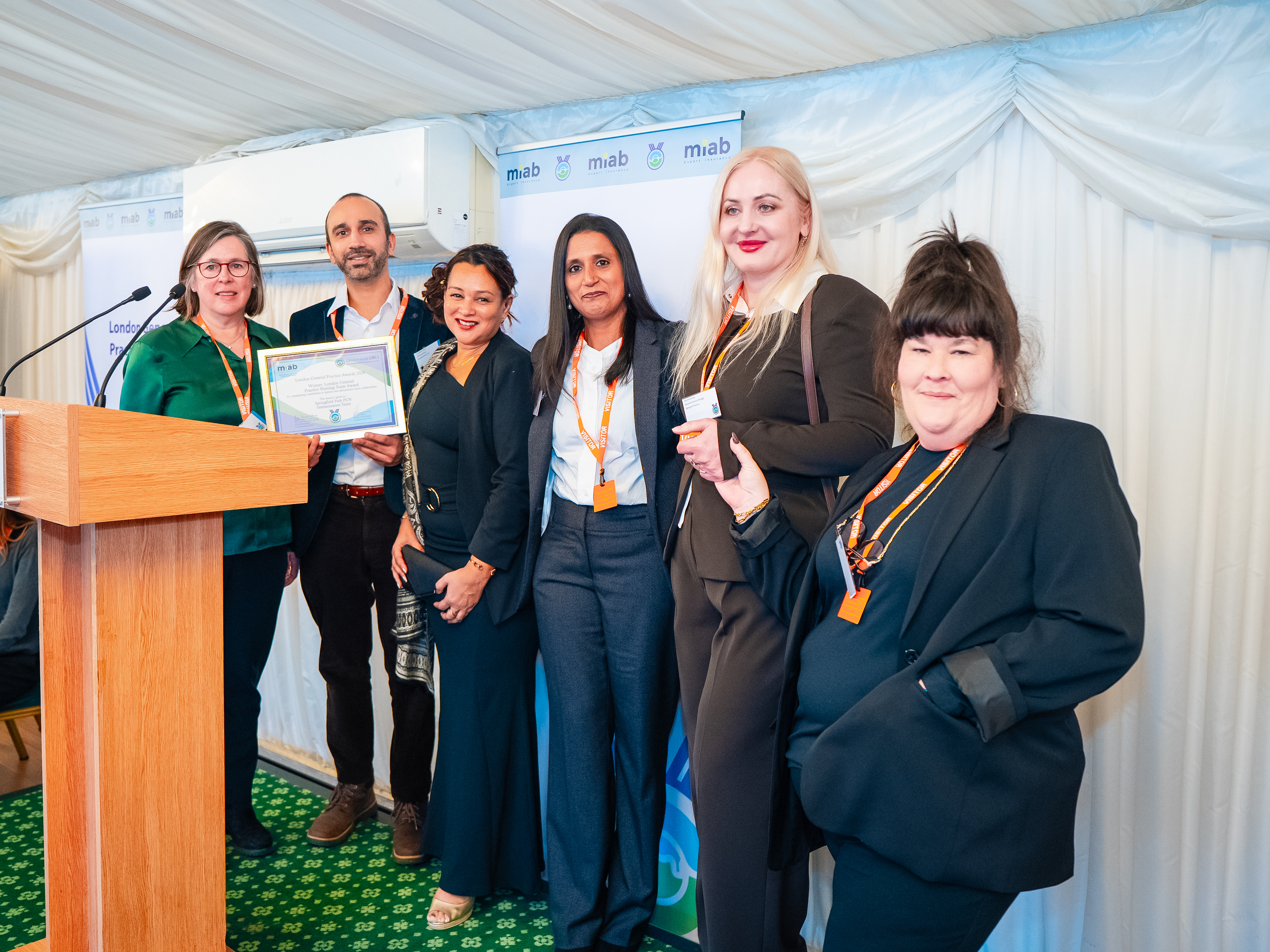
Gill Rogers, one of the judges and the team of Springfield Park PCN.
At the London General Practice Awards on 5 February 2026, Tehseen Khan and his team were recognised as the winners of the London General Practice Nursing Team Award.
“We were awarded because of how collaboratively we work, across the three practices within the Springfield Park Primary Care Network (PCN) and with our wider community partners. We have strong relationships with the public health team and other local organisations, and that makes a huge difference,” Tehseen, the Clinical Lead said.
He continued, “During last year’s measles outbreak, we learned the first case happened on a Friday, and by the Monday we had convened a multi‑stakeholder meeting with practice managers, the UK Health Security Agency, the local public health team, community partners, and our community engagement manager.
By Wednesday, we had mobilised additional vaccination clinics, and on the following Sunday, we ran a large vaccination centre staffed by seven nurses. Although we routinely offer Sunday vaccination clinics, this required significant scaling up. We were able to mobilise so quickly because of the strong relationships across primary care and with partners throughout the wider system.”
Caring for some of East London’s greatest diversity
The practice located in City and Hackney, serves around 17,000 residents and is one of the area’s largest primary care teams.
Tehseen stated that, “The practice is made up of at least 14 GPs, three nurses, healthcare assistants, and a wide range of PCN additional roles, including first‑contact physiotherapists, a mental health nurse, health and wellbeing coaches, social prescribers, and care coordinators.”
The practice covers one of the most deprived areas of London, facing complex health and social challenges.
“Around 60% of the local population is ultra‑Orthodox (Charedi) Jewish, alongside significant Turkish‑speaking, Spanish‑speaking and Indian communities. This creates a very diverse mix of needs, cultures, and languages,” Tehseen explained, noting how this shapes their approach to engagement and services.
A practice embedded in its community
The practice currently hosts “Together Better,” a volunteer‑led community programme running walking groups, English language classes, a men’s Orthodox Jewish walking group, yoga sessions, arts groups and regular coffee mornings. Many activities take place within the practice building.
He highlighted the story of one long‑term patient with complex mental and physical health problems whose life changed dramatically after joining the practice’s arts group.
“She found connection and purpose. Her health improved, her isolation reduced, and she now needs far fewer medical appointments.”
Another success has been recruiting volunteers from underserved communities into paid roles.
Tehseen continued, “One volunteer from the Orthodox Jewish community began helping with vaccination recall calls and was later employed by the practice. We create opportunities within primary care to invest in people. In this case, it changed that person’s trajectory – they had been out of work, and through our support, they are now employed.”
Challenges ahead
Despite a modern, recently constructed building, space remains tight as additional PCN roles continue to expand. Tahseen’s biggest concern is uncertainty over future NHS structures and funding.
“Our immunisation programme depends on PCN‑level funding. As the Integrated Care Systems (ICS) and NHS England undergo changes, we do not know what support will continue. Innovation and community outreach require investment.”
Above all, Tehseen emphasised the practice’s commitment to working with its diverse community.
“The key thing is that we co‑produce our solutions with our communities and genuinely listen to their insights. We have a strong two‑way dialogue: we gather feedback, respond to it, and tailor our communication and service accordingly. This ensures our approach is specific to the communities we serve, particularly for prevention work such as vaccinations and cancer screening. This way of working is central to everything we do.”