

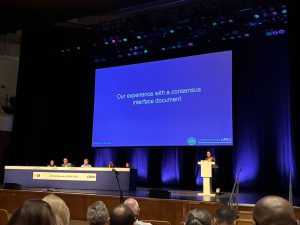
At the 2026 UK LMC Conference, held in Belfast from 13-15 May, representatives from LMCs in North Central London (NCL) gave a presentation on the development of the consensus document on the interface between primary and secondary care and the GP Feedback and Alert Form for NCL. The speakers were Dr. Toni Hazell, Chair of Haringey LMC, Dr. Farzana Vanat, Co-Chair of Barnet LMC, and Dr. Pippa Vincent, Co-Chair of Enfield LMC.
Both documents took a significant amount of careful planning and negotiation as well as lengthy discussions around implementation. They represent a substantial step forward in numerous areas. Londonwide LMCs would like to congratulate all those in NCL who contributed on their work and how it is being recognised on this national stage.
The Feedback and Alert form is an important interface mechanism which builds on the consensus document and provides GPs with a single form to raise queries and alerts, with built in escalation depending on the level of patient risk. Escalation is entirely automated and software has been built to allow this automation. Without this, the volume of alerts would become unmanageable with current admin resources. The form will allow structured insight into system issues and will be used for quality improvement processes. This outcome could not have been achieved without the support of the ICB and NCL LMC would like to thank the key people who were involved at the ICB. We will continue to work locally to ensure that all GPs in NCL are aware of both documents and use them regularly. Anyone who wishes to know more about the automation process is welcome to contact the speakers or Londonwide LMC.
This work is representative of how LMCs across London are working behind the scenes, day-in, day-out on an issue that affects everyone working in general practice, supported across the London region by Londonwide LMCs. Contact details for individual LMCs can be found here, for anyone working in a London practice who has an issue they would like to raise.
The full presentation can be viewed here. Those interested in implementing a similar system might also want to look at the GP feedback and alert pathway, the quick guide on when to raise a concern, the feedback and alert pathway FAQs and the tips for completing the form document. An editable Word version of the form is available here.
We have pulled out the main points on what was agreed below, while the slides also detail:
- The challenge in NCL in terms of size of patient population, complexity of need and number of different providers.
- The process of pulling together different sources of guidance to back up what is reasonable to ask of GPs and the negotiations on combining them into a single approach.
- How the LMCs used NHS initiatives such as the Red Tape Challenge and Getting it Right First Time to support their work.
- How implementing what is in the consensus document is back-stopped by a single point of access for GPs to raise concerns or issues relating to interface. The recent LMC newsletter to practices in NCL details how the form works in EMIS.
What was agreed
The Chairs outlined the key principles that were agreed as underpinning the work of both GPs and specialists:
- Treat all colleagues with respect and keep the patient at the centre of all we do.
- Clinicians should seek to undertake any required actions themselves without asking other teams or services to do this.
- Whoever requests a test is responsible for the results of that test.
- The clinician who wishes to prescribe medication for the patient should undertake appropriate pre-treatment assessment and counselling.
- Try not to commit other individuals or teams to any particular action or timescale.
They also the principles secondary care have committed to across NCL:
- Clear and timely communication to the GP.
- Do not ask GPs to do tests for you – arrange community phlebotomy if needed close to home.
- Give a fit note if needed.
- Prescribe from outpatients if needed immediately.
- Discharge medications to cover at least 14 days.
- Do not ask GPs to prescribe medications on the red list/not on formulary.
- Do not automatically refuse a referral if it does not appear to fit the pathway – not all patients fit pathways.
- Put follow up plans in place for patients who self-discharge.
- DNAs not to be automatically discharged without clinical review.
- Arrange onward referral without referring back to the GP where appropriate.
In turn, local GPs signed-up to these commitments when referring to secondary care:
- Clear letter including patient expectation, not just copy of last consultation.
- Provide an up-to-date medication list.
- Carry out appropriate primary care assessments and where possible optimise long-term conditions if surgery is likely to be needed.
- Avoid abbreviations and acronyms.
- Advise the patient that waiting times are long and appointments may be remote.
- Consider the use of Easy Read patient leaflets (where available) to inform patients about their condition.